


Observation on the Dynamics of the Non-woven Bag Industry
2025-09-22 |Industry
In 2025, driven by both policy adjustments and market demand, the non-woven bag industry is undergoing a transformation from scale expansion to quality upgrading. As an alternative to traditional plastic products, polypropylene (PP) non-woven bags have captured 63% of the domestic raw material market share due to their recyclable nature. However, the industry still faces core challenges such as technological iteration and correction of environmental awareness.
Technological breakthroughs are reshaping industrial competitiveness
Recently, leading domestic enterprises have upgraded the spunbonding process, shortening the degradation cycle of non-woven fabrics outdoors to 90 days and extending their indoor service life to 5 years. A water-based ink printing technology developed by a certain manufacturer in Guangdong has increased the number of times the bag body patterns can be washed by 300%, driving a 15% increase in the brand's repurchase rate. It is worth noting that the global industrial chain is building a production closed loop: British enterprises generate 500,000 kilowatt-hours of electricity annually from waste materials, while domestic manufacturers process scraps into artificial fiberboards, replacing 2 million cubic meters of logs annually. These innovations have addressed the issue of high energy consumption in traditional nonwoven fabric production, but the industry still needs to overcome the recycling challenge brought about by the 23% proportion of polyester fibers (PET).
Market differentiation gives rise to niche markets
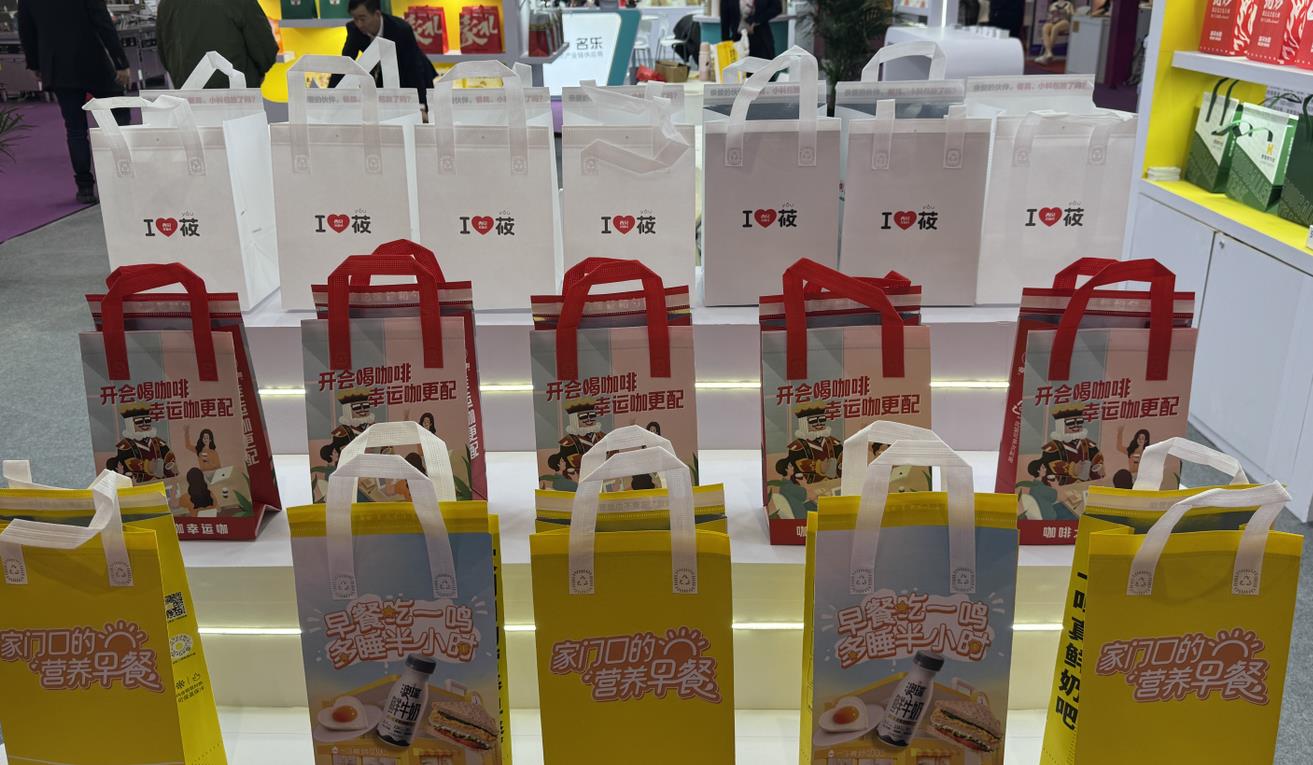
The demand for takeout bags in the Yangtze River Delta region has soared. The lamination process has increased the cleaning efficiency by 60% and driven up the store turnover rate by 35%. In the field of agricultural product packaging in North China, 5-kilogram load-bearing vest bags have replaced 300 traditional plastic bags, with a household usage cycle of up to 8 months. According to the 2025 industry report, the penetration rate of film-wrapped non-woven bags in the fresh food sector has increased by 28% year-on-year, while the conventional type maintains a 65% share in the supermarket channel. This differentiation has prompted enterprises to accelerate the layout of differentiated production capacity. Currently, the Pearl River Delta region has formed a complete industrial cluster ranging from raw material processing to terminal design.
Sustainable practices are facing cognitive upgrades
Although 76.4% of consumers still consider non-woven bags as eco-friendly products, industry data shows that a single non-woven bag needs to be reused 11 times to offset its carbon emissions. In response to this, Shanghai, Shenzhen and other places have piloted "trade-in for new" recycling programs, increasing the average usage times of bags from 3.2 times to 7.8 times through points incentives. The China Industrial Textiles Association emphasized that in the next three years, the industry's focus will shift to establishing a full life cycle management system, including raw material traceability, process emission reduction and usage tracking.
At present, the non-woven bag industry is in a critical period of revaluation. With the market share of GRS-certified products exceeding 40% and the revised version of the "Action Plan for Plastic Pollution Control" about to be released, technical compliance and scene innovation capabilities will become the core elements for enterprises to break through. This industrial evolution from substitutes to true environmental protection is reshaping the green standards of the packaging industry.
 上一篇
上一篇
